
AI Adoption for Small and Mid-Sized Businesses: Why Strategy Matters More Than Tools
Most small and mid-sized businesses are not struggling with AI tools. They are struggling with AI adoption. And the issue isn’t resistance. It’s the absence of a clear learning and enablement strategy.
The AI Adoption Challenge Facing Small and Mid-Sized Businesses
For many SMBs, 2026 planning includes AI. AI is expected to:
• Increase productivity
• Reduce operational friction
• Improve internal training
• Accelerate customer education development
• Enhance efficiency without increasing headcount
But in lean organizations, adoption often looks like employees experimenting individually and leadership expecting measurable productivity gains. The problem here is that no one owns the enablement strategy. That gap creates inconsistency, inefficiency, and wasted investment.
While large enterprises can absorb trial-and-error cycles, small and mid-sized businesses cannot. When an SMB is possibly dealing with a limited staff, reduced headcount due to layoffs, not having a dedicated L&D executive, or maybe having responsibility for both internal staff training and customer education, they require strategy. AI must be implemented strategically.
Without a structured AI adoption strategy, organizations experience:
• A handful of power users
• Inconsistent outputs across teams
• Compliance and governance concerns
• Underutilized AI licenses
• Frustration from leadership
AI becomes an experiment instead of a growth lever.
AI Enablement Is a Learning Strategy Issue
AI implementation isn’t a technology problem. It’s actually a learning, systems, and behavior change initiative. The companies seeing real productivity gains are not the ones using the most AI tools.
They are the ones with clarity around where and how AI should be used in their organization. They implement role-specific workflows, quality standards, and review processes. They understand the importance of governance and compliance guardrails. In addition, the set measurable measurable adoption benchmarks. This type of clarity requires strategic learning leadership.
AI and Customer Education: The Overlooked Opportunity
Many small and mid-sized businesses are also responsible for building educational products for customers.
AI can significantly increase efficiency in:
• Course development
• Content research
• Documentation creation
• Knowledge base expansion
• Onboarding materials
But without a scalable learning system in place, AI accelerates inconsistency instead of quality. Internal enablement and customer education must be aligned under one strategic learning framework.
Why Fractional LxD Strategy Makes Sense for SMBs
Not every small business needs a full-time Chief Learning Officer. But many need senior-level learning strategy to help them design an AI enablement roadmap, align AI usage with their business goals, and build scalable internal systems. An effective strategy also helps improve customer education products and increases team capability without adding additional people to their payroll.
A Fractional LxD Strategy partner provides leadership without the overhead. It doesn’t replace your existing team, it adds the right people to your team when you need it. For small and mid-sized businesses navigating AI adoption, this model offers structure, clarity, and measurable progress.
If AI Is on Your 2026 Priority List
If you’ve been thinking about how to integrate AI in your business, ask yourself these questions:
Does someone clearly own AI adoption strategy?
Is AI use aligned with defined workflows?
Are internal teams trained consistently?
Are customer education programs benefiting from AI efficiencies?
Is adoption measurable?
If the answer is no, the issue is not tools. It’s strategy. And strategy is a learning leadership decision.
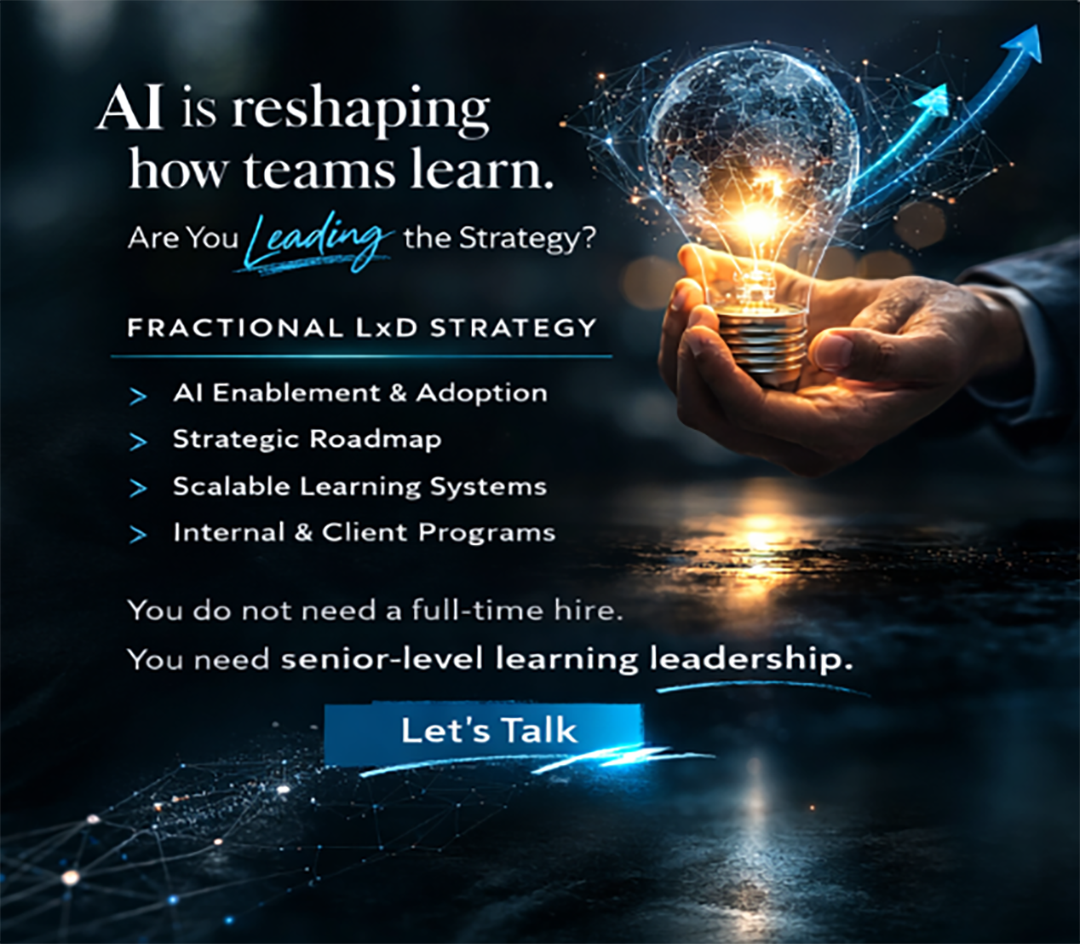
Who owns AI adoption in your organization?
If the answer is unclear, that’s your starting point.
Let’s discuss how Fractional LxD Strategy can bring structure, clarity, and measurable impact to your AI initiatives.
Schedule a strategy call.